Explore collaborative shopping lists
This .NET 10 sample connects HTTP commands, event-sourced actors, live orchestration, SQLite projections and linked read models. Its Vue application uses the same HTTP API. All framework references come from public NuGet packages.
On this page
Run locally
From the repository root, start the silo:
dotnet run --project Sample/ShoppingListSample/Sample.Host
In a second terminal start the API:
dotnet run --project Sample/ShoppingListSample/Sample.Api
The API listens at http://localhost:8081. Open /swagger to inspect routes. The Orleans sample silo uses ports 9000 and 9001. For a single process:
dotnet run --project Sample/ShoppingListSample/Sample.Api -- --Shopping:EmbeddedHost=true
Both hosts resolve SQLite to the same local application data directory, TroolioSamples/shopping/readmodels.db. To choose another location, set Shopping__ReadModels__Path to the same absolute path in both terminals. The sample filesystem event store uses troolio-samples-shopping under the user's application data directory. Set Shopping__EventFolder to choose another owned event folder. Both are local development stores. SQLite is a relational projection demonstration, not a multi-node deployment configuration.
Docker runs the embedded variant with persistent local volumes:
docker compose -f Sample/ShoppingListSample/docker-compose.yml up --build
Demo identity
GET /demo/users returns three fixed teaching identities: Alice, Bob and Carol. Send Authorization: Bearer demo-alice, demo-bob or demo-carol. Alice's ID is 11111111-1111-1111-1111-111111111111; Bob's is 22222222-2222-2222-2222-222222222222. A conflicting userId header is rejected. The verified identity supplies command UserId and read authorization. These publicly known credentials are suitable only for local learning. The API refuses to start outside Development/Testing; replace the demo scheme with your identity provider before deployment.
curl http://localhost:8081/demo/users
curl -X POST http://localhost:8081/ShoppingList/aaaaaaaa-1111-1111-1111-111111111111/CreateNewList \
  -H 'Authorization: Bearer demo-alice' -H 'Content-Type: application/json' \
  -d '{"title":"Weekend groceries"}'
curl http://localhost:8081/User/11111111-1111-1111-1111-111111111111/MyShoppingLists?take=50 \
  -H 'Authorization: Bearer demo-alice'
Commands and pure replay
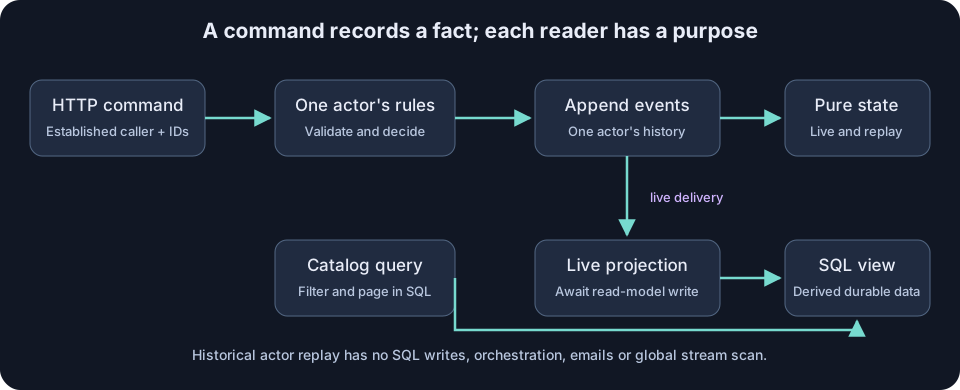
A command validates the caller and current aggregate state before producing domain events. Event handlers restore only the owning actor's state; they do not send mail or write projections during replay.
public IEnumerable<Event> Handle(JoinList command)
{
    if (State.Author == command.Headers.UserId)
        throw new AuthorCannotJoinListException();
    if (State.Collaborators.Contains(command.Headers.UserId))
        yield break; // Repeated orchestration delivery has the same domain outcome.
    yield return new ListJoined(command.Headers);
}
public void On(ListJoined e)
    => State = State with { Collaborators = State.Collaborators.Add(e.Headers.UserId) };
ShoppingListActor owns title, author, items and collaborators. Author and collaborator can add/cross off items; only the author can remove items or request a join code. Individual aggregate queries carry the verified user ID and enforce membership.
Orchestration and metadata
Creating a list generates a random join code once and stores it in the creation event. The live orchestrator registers that list in the join-code index. Registration and membership targets tolerate repeated deliveries.
public Task On(EventEnvelope<NewListCreated> e)
    => System.ActorOf<IAllShoppingListsActor>(Constants.SingletonActorId)
        .Tell(new AddShoppingList(e.Event.Headers, Guid.Parse(e.Id), e.Event.JoinCode));
Pass the original event headers into an internal command. Core gives the child command its own message ID and sets its causation ID to the source message ID. Correlation ID connects one logical request, user ID identifies the verified caller, and device ID is a client-reported diagnostic identifier. Send correlationId and deviceId as GUID headers; the API echoes a valid correlation ID or generates one when absent. These diagnostic headers do not grant permissions. EventEnvelope.Id is the source actor key; it is not an event deduplication key. Domain list/item/member IDs drive idempotency.
Ordinary listener delivery is eventual. A successful create does not mean every orchestration and projection has finished, and an ordinary listener failure does not roll back every actor. Refresh/poll read models with a bounded timeout. Applications requiring durable handoff, atomic routes or external effects must configure the corresponding framework capabilities explicitly.
Durable catalogs and linked read models
The EF extension projects committed live events into lists, items and memberships. A deterministic member ID derived from list ID and user ID prevents duplicate memberships. Catalog HTTP reads query SQLite directly with caller filtering, skip and take (maximum 100). They never scan all event streams or activate every list actor.
var lists = await db.ShoppingLists.AsNoTracking()
    .Where(list => db.ShoppingListMembers.Any(member =>
        member.UserId == caller && member.ShoppingListId == list.Id))
    .OrderBy(list => list.Title).ThenBy(list => list.Id)
    .Skip(skip).Take(take).ToArrayAsync();
ShoppingListReadModelProjectionActor separately links events for one list's detailed historical model. The HTTP endpoint explicitly evaluates Authorized before returning it. Catalogs use the indexed relational view; a linked single-model resolver has a different cost profile.
var model = await client.Get<ShoppingListReadModel>(listId.ToString());
if (!model.Authorized(verifiedHeaders)) return Forbid();
return Ok(model);
Authors see their join codes in the SQL catalog; collaborators do not. To join as Bob, send { "joinCode": "..." } to POST /AllShoppingLists/JoinListUsingCode with Bob's token. Wait for live membership projection before reading Bob's catalog.
Read-model transport
The root linked model derives from TroolioReadModel so Core discovers its reducers. For public Core 10.0.8, this sample supplies an Orleans surrogate converter for transport because that base record does not provide its own generated base codec. The surrogate contains only model data; authorization remains a computed predicate and is excluded from HTTP JSON. The Shared project references Microsoft.Orleans.Sdk, which discovers [RegisterConverter] during source generation; clients and hosts both reference that Shared assembly.
[GenerateSerializer]
public struct ShoppingListSurrogate
{
    [Id(0)] public Guid Id;
    [Id(1)] public string Title;
    [Id(2)] public Guid OwnerId;
    [Id(3)] public ImmutableArray<Guid> Collaborators;
    [Id(4)] public ImmutableArray<ShoppingListItemReadModel> Items;
    [Id(5)] public string JoinCode;
}

[RegisterConverter]
public sealed class ShoppingListConverter
    : IConverter<ShoppingListReadModel, ShoppingListSurrogate>
{
    public ShoppingListReadModel ConvertFromSurrogate(in ShoppingListSurrogate value)
        => new(value.Id) { Title = value.Title, OwnerId = value.OwnerId,
            Collaborators = value.Collaborators, Items = value.Items, JoinCode = value.JoinCode };
    public ShoppingListSurrogate ConvertToSurrogate(in ShoppingListReadModel value)
        => new() { Id = value.Id, Title = value.Title, OwnerId = value.OwnerId,
            Collaborators = value.Collaborators, Items = value.Items, JoinCode = value.JoinCode };
}
The host additionally initializes Core's linked-model resolver using Orleans 10 per-grain activation components. Register AddShoppingReadModels in the final silo configuration callback, after the default Orleans services:
silo.ConfigureServices(services => services.AddShoppingReadModels());

public sealed class ConfigureReadModelActivation : IConfigureGrainTypeComponents
{
    public void Configure(GrainType type, GrainProperties properties, GrainTypeSharedContext shared)
    {
        if (shared.GetComponent<IGrainActivator>() is { } inner && inner is not ReadModelActivator)
            shared.SetComponent<IGrainActivator>(new ReadModelActivator(inner));
    }
}

public sealed class ReadModelActivator(IGrainActivator inner) : IGrainActivator
{
    public object CreateInstance(IGrainContext context)
    {
        var grain = inner.CreateInstance(context);
        if (grain is IReadModelResolver resolver) resolver.Initialize(context.ActivationServices);
        return grain;
    }
    public ValueTask DisposeInstance(IGrainContext context, object grain)
        => inner.DisposeInstance(context, grain);
}
AddShoppingReadModels registers ConfigureReadModelActivation as IConfigureGrainTypeComponents. See Sample.Host.App/ReadModelActivator.cs for the complete helper. Do not serialize delegates or rely on transport to authorize a read; the HTTP handler still checks the current verified caller.
Tracing and external effects
Authenticated demo users can enable/disable tracing and flush it using /Telemetry. The email actor is a mock and the batch queue is in memory. This illustrates routing, not durable or exactly-once email delivery. Real providers need durable dispatch and provider idempotency before external sends.
Try a bounded load
dotnet run --project Sample/ShoppingListSample/Sample.LoadTest -- 10
The load utility creates 1–1000 lists sequentially against a disposable local database; it is a smoke tool, not a capacity benchmark.
The former MySQL migrations and unused logging filter have been retired. This fresh SQLite teaching schema uses EnsureCreated; it does not migrate existing MySQL data. For a deployed application, provision versioned schema migrations separately from serving startup.
Provider references: EF SQLite and Orleans serialization.
Complete source and packages
Open Shopping List on GitHub. It uses public Troolio.Core 10.0.8 and Troolio.Projection.EntityFramework 10.0.2. See EF projections, metadata lineage, and orchestration for the framework concepts behind each handler.